






Vendors we would not order from today
Facts read on their pages, not opinions. Set aside before scoring: Ion Peptide, Apex Peptides, Swiss Chems, Purerawz (no blend listed, a login wall, or an affiliate page that does not sell). Scored but low on the grid: Modern Aminos; the table above shows what each one lacks.
How we ranked them
Seven criteria, 10 points, applied to every vendor from what its own pages showed on 21 Sep 2026. S is 9 or more, A is 4 to 8, B is 2 to 3, C is under 2. The weighting is our editorial choice; this site is published by OX RESEARCH LTD, the company behind OXpeptides, which is why every fact about the other vendors is dated and quoted so you can check it. The full survey is a JSON file any reader can ask for at editor@cjc-1295-ipamorelin.com.
- 2 pts A registered company with its number on the site
- 2 pts The lot number printed on every vial
- 1 pt Purity specified at 99 % or more by HPLC and MS, per lot
- 2 pts Ships in 1 to 2 business days, tracked, with a reship guarantee
- 1 pt Card payment with 3-D Secure
- 1 pt Ships to the US and to Europe
- 1 pt Testing laboratory named
Two molecules that do not do the same thing
The phrase "CJC-1295 ipamorelin" names a pair, not a compound. CJC-1295 was built at ConjuChem in Montreal as a growth-hormone-releasing hormone (GHRH) fragment that would last longer than the native hormone: four amino acids were swapped to resist enzymatic cleavage, and a maleimide group was added on a thirtieth lysine so that the peptide binds covalently to cysteine 34 of serum albumin after injection [7]. That linker is the "DAC", and it is why the human half-life came out at 5.8 to 8.1 days [1].
Ipamorelin came out of a different programme, at Novo Nordisk in Denmark. It is five residues long, it binds the receptor that ghrelin later turned out to occupy, and it was selected precisely because it released GH without the cortisol and prolactin that earlier GHRPs also released [3]. Its terminal half-life in men is about 2 hours [4].
The vial sold under the combined name in the research market almost always contains the linker-free version of CJC-1295, called Mod GRF 1-29 on forums, together with ipamorelin. If the reason for that choice is not obvious, the guide on CJC-1295 DAC versus no DAC walks through it: a linker designed to keep a peptide in the blood for a week has no logic next to a peptide cleared in two hours.
Why the two are studied together
The figure below is the one measurement that matters here: growth hormone comes in pulses, and a week-long GHRH signal lifted the floor between them without touching the pulses themselves.
Figure 2
Growth hormone is released in pulses, mostly at night. A GHRH-type peptide raises the amount available for each pulse; a GHRP-type peptide acts through a second receptor, the one ghrelin binds, and the two effects add up to more than either alone. In 1990, Bowers and colleagues gave 18 normal men GHRP-6 alone, GHRH(1-44) alone, and the two together: the submaximal doses of GHRP-6 combined with 1 µg/kg GHRH released GH synergistically, more than the sum of the two alone [6]. Every "stack" argument since then rests on that observation.
- GHRH receptor receptorAmount
- Ghrelin receptor receptorTrigger
- Both at once receptorBigger burst
The second thing the record shows is that a long-acting GHRH analogue does not flatten the rhythm. Ionescu and Frohman sampled blood every 20 minutes through the night before and one week after a single injection of CJC-1295: the pulses kept their number and their height, the trough between them rose 7.5-fold, mean GH rose 46 % and IGF-1 45 % [2]. The mechanism, the receptors and the vocabulary are laid out in what is CJC-1295 ipamorelin.
| Study | What the authors wrote |
|---|---|
| Teichman et al., 2006 J Clin Endocrinol Metab, two placebo-controlled trials | After a single injection of CJC-1295, there were dose-dependent increases in mean plasma GH concentrations by 2- to 10-fold for 6 d or more and in mean plasma IGF-I concentrations by 1.5- to 3-fold for 9-11 d. |
| Ionescu and Frohman, 2006 J Clin Endocrinol Metab, overnight sampling | GH secretion was increased after CJC-1295 administration with preserved pulsatility. The frequency and magnitude of GH secretory pulses were unaltered. |
| Raun et al., 1998 European Journal of Endocrinology, Novo Nordisk | Very surprisingly, ipamorelin did not release ACTH or cortisol in levels significantly different from those observed following GHRH stimulation. |
What the human trials measured
| Study | Who | What was given | What was found |
|---|---|---|---|
| Teichman 2006 [1] | healthy adults, 21 to 61 | CJC-1295 DAC, four single doses; then weekly or biweekly | GH 2 to 10-fold for 6 days or more; IGF-1 1.5 to 3-fold for 9 to 11 days; half-life 5.8 to 8.1 days |
| Ionescu 2006 [2] | healthy men, 20 to 40 | CJC-1295 DAC, 60 or 90 µg/kg once | trough GH ×7.5, mean GH +46 %, IGF-1 +45 %, pulses unchanged |
| Gobburu 1999 [4] | healthy men, 8 per dose | ipamorelin, 5 intravenous rates | half-life 2 h; one GH episode peaking at 0.67 h |
| Beck 2014 [5] | 114 bowel-resection patients | ipamorelin 0.03 mg/kg IV twice daily, up to 7 days | adverse events 87.5 % vs 94.8 % placebo; primary endpoint not met (p = 0.15) |
That is the whole human record for the two molecules: two trials for CJC-1295, one pharmacokinetic study and two phase 2 trials for ipamorelin, one of which has never published its results. The doses used in each are tabulated, with the DOI beside each figure, in the dosage guide. What the trials recorded as adverse events is in CJC-1295 side effects and ipamorelin side effects.
The submaximal dosages of 0.1 and 0.3 microgram/kg GHRP plus 1 microgram/kg GHRH stimulated GH release synergistically.
What is not known
Three gaps matter more than the rest. First, the combination has never been given to people in a published trial, so any claim about "CJC-1295 ipamorelin results" is an extrapolation from separate studies. Second, the linker-free CJC-1295 that fills the research vials has no human pharmacokinetic study of its own; its clearance is inferred from the parent GHRH(1-29) sequence. Third, both development programmes stopped: ConjuChem's phase 2 trial in HIV-associated visceral fat was terminated in 2006, and Helsinn's 320-patient ipamorelin trial completed in 2014 without posting results. The CJC-1295 peptide and ipamorelin peptide guides tell each story to its end.
Regulatory status follows from that. Neither molecule is approved by the FDA or the EMA. In September 2023 the FDA placed ipamorelin acetate in category 2 of its list of compounding bulk substances that may present significant safety risks, on the ground of possible immunogenicity [8], and both molecules are named in class S2 of the WADA Prohibited List [9]. Tesamorelin, a cousin of CJC-1295 that did complete its programme, is the useful counter-example: CJC-1295 ipamorelin versus tesamorelin.
What is in a "CJC-1295 ipamorelin" vial
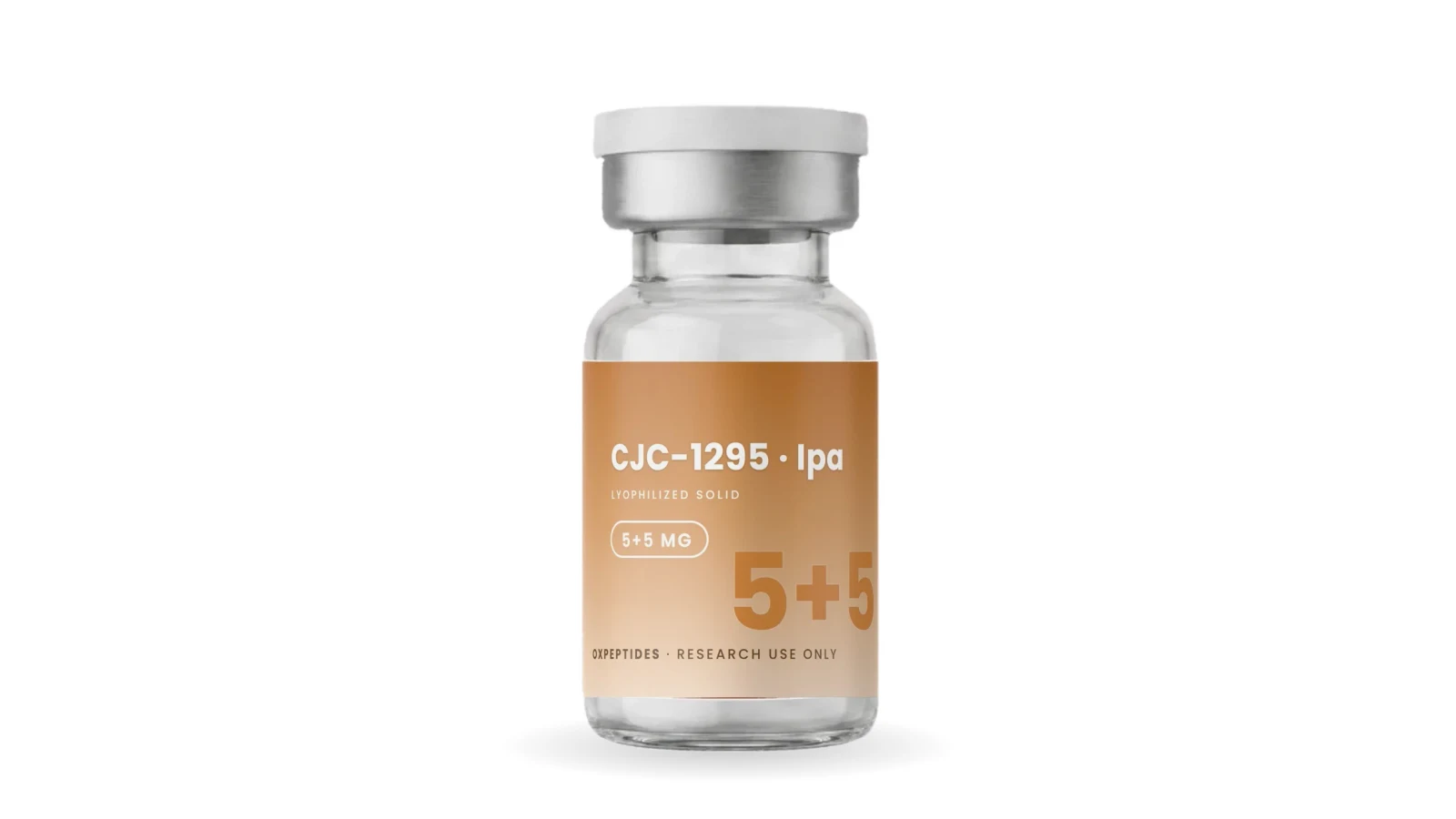
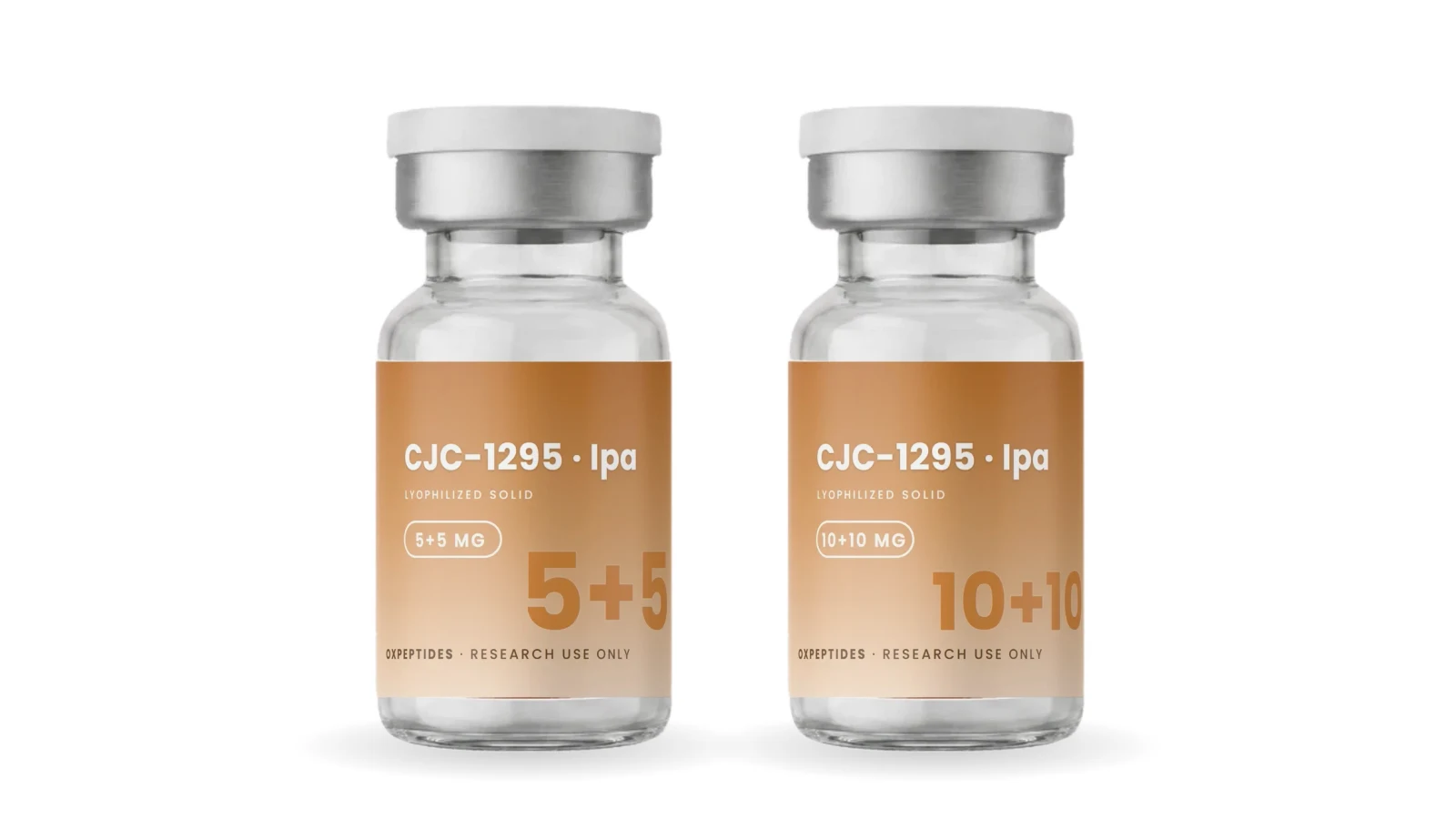
In the research-use market the combined name designates one lyophilized vial holding both peptides in equal mass, typically 5 mg of Mod GRF 1-29 and 5 mg of ipamorelin in a 10 mg vial. Because the two molecules differ in mass by a factor of almost five (3,367.9 against 711.9 g/mol), equal mass means about 4.7 molecules of ipamorelin for every molecule of the GHRH analogue. A certificate of analysis for such a vial has to show two HPLC peaks and two masses, one of them 3,368 rather than 3,647, or the vial is not what its label says. The for-sale guide lists the nine things a listing must state. The blend at OXpeptides prints the lot on every vial and names its laboratory, Janoshik; the certificates of the September 2026 lots are being published.